


TAMIDS’s Student Data Challenge is an open-ended data science competition where teams identify a goal and develop a final report and presentation.
Competition Overview
The Data Challenge is held over a seven-week period, starting with the Kick-Off Session and ending with the Final Event. All competitors have five (5) weeks to conduct their analysis, write a report, and submit it by the deadline. Selected finalists will be invited to give a presentation before a panel of judges during the Final Event.
All teams have five (5) weeks to:
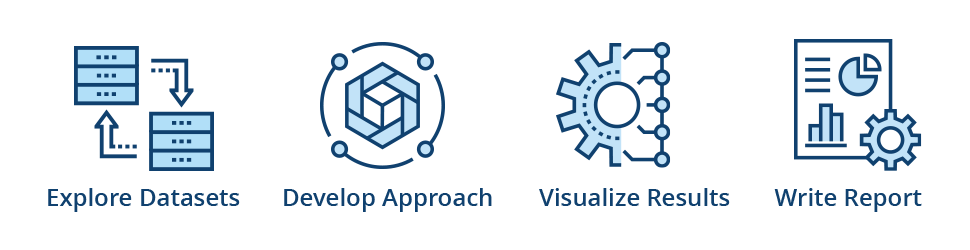
The teams with the best reports in each division are selected as finalists and given one week to prepare a presentation for a panel of judges during the Final Event.
Additional activities, such as the Midpoint Event, Workshop, and Q&A, are optional. Teams are encouraged to submit the optional Midpoint Summary for a chance to win a special “Best Visualization” prize.
Competition Setting and Theme
Each year, the competition organizers select a new theme to reflect emerging trends and interests in science, technology, and world events. This dynamic approach ensures that participants tackle fresh, relevant challenges, encouraging innovative solutions to real-world problems. The evolving themes keep the competition engaging and encourage new participants from across Texas A&M’s departments and colleges.
Challenge Prompt
Student teams are given an initial dataset and challenge prompt, then have five (5) weeks to create an innovative and narrative-driven analysis to help a target stakeholder make more informed decisions or better understand a challenge they face.
The challenge prompt and dataset(s) will be posted on the Competition Portal during the Kick-off Session and will be available to registered competitors after the competition begins. Students are encouraged to attend the orientation session to learn more about the
The competition values creativity and innovation in projects.
Teams should formulate a specific approach within the broad problem context. This approach might involve finding and using additional data and information for a specific industry, context, or community. Each team will choose a focus area, define their metrics, develop a model, and show insights and recommendations based on their analysis.
There are three main components to this challenge:
1. Identify a Community, Stakeholder, or Impacted Group
Data analysis does not exist in a vacuum; its value is measured by its ability to drive meaningful action. Every organization needs to make informed decisions to achieve its goals, but the “right” decision depends entirely on which questions are being asked and how they are answered. To ensure your work is relevant and impactful, teams must identify a specific target stakeholder that will be impacted by their data analysis. This focus will guide your research questions, shape your analytical methods, and determine how you present your final conclusions.
To successfully complete this part of the challenge, you should:
- Define Your Audience: Clearly state who your primary stakeholder is. Is it executive leadership focused on strategic growth, an operational team concerned with efficiency, government regulators ensuring compliance, or the general public as end-users of a service?
- Understand Their Needs and Goals: Go beyond just naming your stakeholder. What are their key responsibilities? What critical decisions do they need to make? What challenges or “pain points” are they currently facing that your analysis could help solve?
- Tailor Your Analytical Scope: Your choice in stakeholder should directly influence your analysis. The metrics that matter to a CEO (e.g., long-term market trends, financial forecasting) are fundamentally different from those that matter to a department manager (e.g., daily resource allocation, process bottlenecks).
- Frame the Problem Statement: Formulate a clear problem statement from the perspective of your chosen stakeholder. Instead of a general goal like “analyze the dataset,” a focused goal might be, “Provide the logistics department with recommendations to reduce delivery times by 10%,” or “Inform policymakers on the potential impact of a new initiative.”
Successfully identifying and understanding your stakeholder is the foundational step that transforms a technical exercise into a powerful tool for decision-making.
2. Conducting Descriptive, Diagnostic, Predictive, or Prescriptive Analytics
Using the provided datasets and other publicly available data, competitors should:
- Conduct Descriptive Analytics: Explore historical data to summarize key trends, patterns, and notable characteristics.
- Perform Diagnostic Analytics: Identify the root causes of observed outcomes by analyzing patterns, anomalies, and correlations within the data.
- Apply Predictive Analytics: Use machine learning or statistical modeling to forecast future outcomes or trends based on historical data.
- Develop Prescriptive Analytics: Provide actionable recommendations, such as strategies for intervention, process improvements, or optimized decision-making frameworks.
Competitors are encouraged to analyze real-world data, draw insights, and propose solutions that address a defined problem or improve future outcomes.
3. Communication with End-Users
The implications of data analysis can affect entire organizations and communities, but not all stakeholders are technical experts. Competitors should focus on:
- Communicating to a Target Audience: Translate your complex analytical findings into actionable insights that a non-technical audience (e.g., managers, executives, policymakers) can understand.
- Tell a Story: Develop clear visualizations and storytelling techniques to communicate key risks, potential opportunities, recommended actions, and the impact of various scenarios.
- Providing Decision-Making Support: Whether addressing an executive, a department head, or a policy team, competitors should aim to offer meaningful and practical recommendations based on their analysis.
All professionals must make informed decisions regardless of their industry or job role. Effective communication of data-driven insights and their implications is as important as the technical analysis itself.
Competition Portal
The competition organizers enroll participating students as teams in a special Canvas course. All announcements, materials, and submissions related to the competition will be posted on the competition’s Canvas webpage and accessible only to students who registered by the deadline.
TAMIDS’s organizers will enroll registrants and configure teams using the details provided in the registration form (see “Registration” below for more details).
Team Formation, Divisions, & Faculty Mentors
Teams: As part of the registration, students will form teams of one to five (1–5) members and enter into the undergraduate or graduate divisions.
Students can use the Data Science Competitions Discord server to find potential teammates.
After the registration deadline, no new students will be allowed to join the competition, but current registrants may change teams up to one (1) week after the competition starts.
Divisions: The competition is split into two divisions: Undergraduate and Graduate. Both divisions use the same dataset(s) and challenge prompt(s), but each is awarded a separate first-, second-, and third-place prize.
Eligibility
The competition is open to graduate and undergraduate students from all majors at Texas A&M University, including the Galveston and Qatar campuses. Competitors must be enrolled as a student at Texas A&M University during the Spring 2025 semester.
- Students can only be on one team per competition
- A team with at least one graduate student will be assigned to the graduate division
Registration
All Student Data Challenge competitors must register using the REGISTRATION FORM by the deadline.
Students can register in teams of one to five (1–5) members. A valid TAMU UIN and email address are required for all team members. All students must provide the following to register:
- First and Last Name
- UIN
- Status (Undergraduate or Graduate)
- Academic Department and Major
2026 Sports Data Challenge Registration Deadline
Sunday, February 22, 2026, at 11:59 PM CST
All registrations will be acknowledged with an automated email. Registrations can be updated to add or remove teammates, but all competitors must be registered by the deadline; otherwise, they will not be included in the competition.
Registered competitors may change teams or merge teams by emailing tamids@tamu.edu, up to one week after the Kick-Off Session. After that week, team members can only be removed from the competition, not added.
Faculty Mentors
[OPTIONAL]
Teams can choose to have a faculty mentor provide guidance. Competitors must obtain the mentor’s agreement to serve in this role before listing them in the registration. Faculty mentors can provide guidance and support for competitors but cannot directly contribute to the competition’s analysis, report writing, or other deliverables. Faculty are not required to submit or participate in any of the competition’s events, but are invited to attend the Final Event with their team.
Competition Milestones & Events
Kick-Off Session
During the Kick-Off Session, competitors will receive a guiding prompt and details about the expectations and goals for their analysis. The orientation session will also include introductory presentations and a quick tutorial to get students started. Students will have the opportunity to meet with the organizers, ask questions, learn about the optional workshop, and explore other resources.
Workshop Q&A [Optional]
The organizers will host an online Workshop and Q&A session covering useful skills and techniques for the competition. Additionally, participants will receive additional guidance during an open question-and-answer session.
Midpoint Showcase [Optional]
Teams may optionally submit a one-page summary graphic of their initial work before the Midpoint Showcase. The submissions will be reviewed by guest judges, and special “Best Visualization” prizes will be awarded to the top team in each division at the midpoint event.
Final Report Submission
Each team will need to submit a final report, with a maximum of ten (10) pages, that details their original analysis, the methods they used, and any recommendations or guidance related to the challenge prompt. The judges will select three to five (3–5) finalists from each division, who will have one (1) week to prepare a ten-minute presentation, followed by a five-minute Q&A with the judges. The top three teams in each division will win prizes as well as special prizes awarded for Best Presentation Design, Best Use of Additional Data, and Best Supplementary Materials.
Final Event
The Final Event will culminate weeks of innovation and hard work as finalist teams present their projects to a distinguished judging panel. It is more than just a competition—it’s a celebration of creativity, teamwork, and data-driven problem-solving. Finalists will showcase their written reports and deliver compelling presentations, competing for top honors and special team prizes. The evening will conclude with the highly anticipated announcement of the competition winners and recognition of outstanding efforts, making it a memorable finale.
Final Report & Materials
Competitors should submit the following through the competition’s Canvas site by posted deadline. Multiple updates are allowed before the deadline, but no late submissions will be allowed.
Report Document
Format: A maximum of 10 pages and a minimum of 10 pt Arial font with 1-inch margins all around. Must be in a PDF file.
Content: Code and supplementary materials are allowed as separate items (and hence do not count toward the 10-page maximum). The report should include the following information at a minimum:
- Executive Summary: the general approach used to address the problem and the summary of insights and recommendations.
- Problem Statement: the specific research problem within the scope of the prompt that your project has addressed.
- Datasets: the selections from the competition datasets used to address the problem, any additional data used (make the use of additional data clear so that we know when and how it has been used), and any preprocessing steps, including cleaning, treatment of outliers or missing values.
- Data Exploration: initial data analysis, exploratory data visualization, and how these informed the problem formulation and solution.
- Methodology: data analysis methods used and your reason for using them.
- Modeling and Analysis: description of models or predictions derived from analysis, discussion of limitations and uncertainties, and possible areas for further analysis.
- Visualization and Interpretation: description of results and data visualizations (including a description of what the visualization is conveying and why it is included in your project).
- Conclusions and Recommendations: summary of the team’s insights on patterns of interdisciplinary research and opportunities to strengthen its impact on public discourse around societal challenges.
Executable Code
- Such as a Jupyter notebook or a link to a GitHub repository; don’t just submit raw code.
- Ask in the Competition’s Discord Server. if you have doubts about your proposed executable code format.
- Reuse is OK, but you must acknowledge any external sources used.
Supplementary Materials (optional but encouraged)
- Such as supplementary figures, a dashboard, a website, or an app
- Ask in the Competition’s Discord Server. if you have doubts about a proposed supplementary materials format.
Final Presentation
Finalists will be invited to submit their final presentations and present at the Final Event.
Format: Each finalist team will deliver a 10-minute live presentation, followed by five (5) minutes for Q&A with the judges.
- Timing will be strictly adhered to. Teams will receive a warning one minute before the end of their time slot, and overruns will be taken into account in the final scoring.
- Presentations should be self-contained in a single PowerPoint file or a similar format. To ensure smooth delivery, any demonstrations of dashboards or other subsidiary material should use media embedded in the presentation, such as screenshots, images, or short videos. Judges have access to the submitted Final Report and Materials to review any subsidiary materials prior to the final.
- Any team or team members who wish to deliver remotely may do so live over Zoom.
Submission: A submission link will be provided as an assignment in Canvas.